
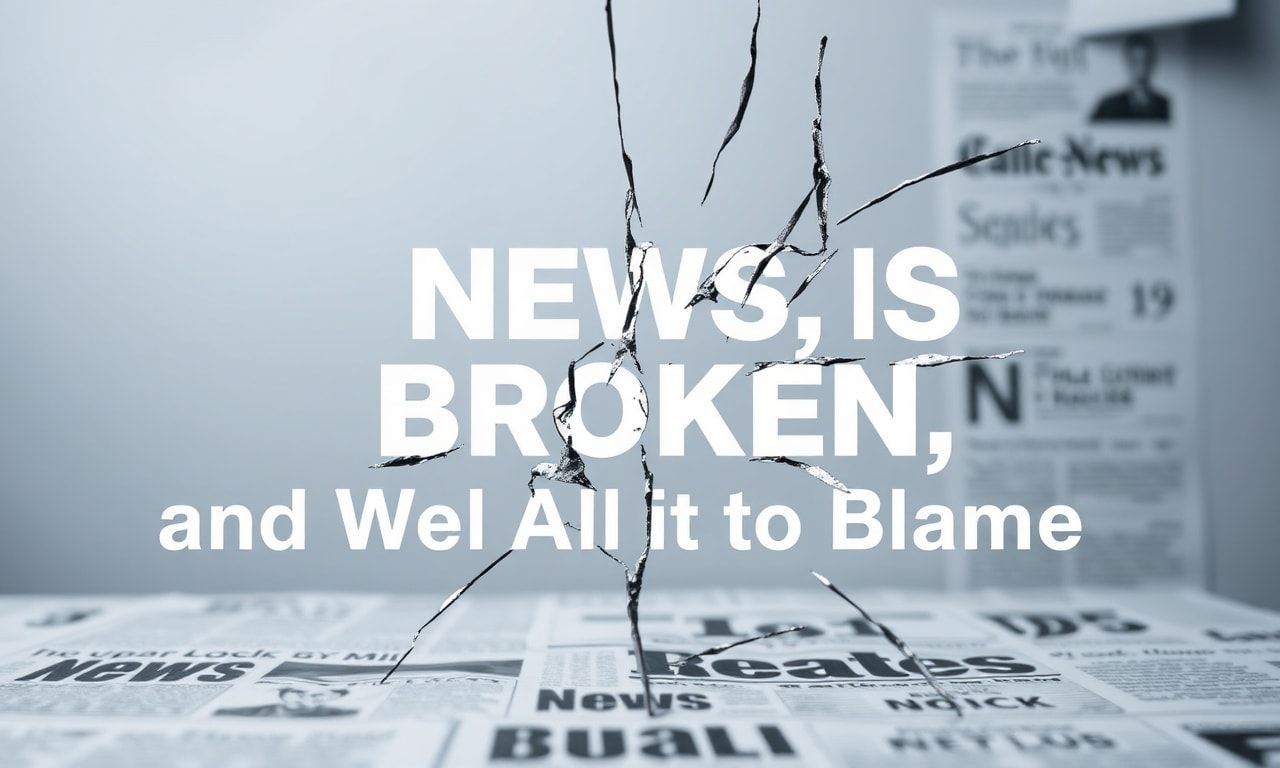
Let’s Talk About the Mess We’re In
Look, I’ve been in this business for over two decades. I’ve seen a lot of things, but honestly, the state of news today? It’s a completley different beast than what I signed up for back in ’98.
I remember sitting in a conference in Austin, Texas, with a colleague named Dave. We were talking about the future of journalism. We laughed about how ridiculous some of the headlines were getting. But even then, we didn’t see this coming.
You ever have one of those moments where you just wanna scream into a pillow? That’s how I feel every time I open a news app these days. It’s not just the sensationalism, though that’s bad enough. It’s the sheer volume of it all. The constant noise. The way everything is framed as a crisis or a scandal or the end of the world as we know it.
We’re All Addicted to the Chaos
And don’t even get me started on social media. I was having coffee with my friend Marcus—let’s call him Marcus, because his real name doesn’t matter—anyway, he’s showing me his Twitter feed. It’s just a never-ending stream of outrage. Every other post is someone yelling about something. And the comments? Forget about it. It’s like watching a car crash in slow motion.
I asked him, “Marcus, do you even read the articles anymore, or do you just scroll through the headlines and the comments?” He looked at me like I was crazy. “Who has time to read the whole thing?” he said. Which… yeah. Fair enough. But that’s part of the problem, isn’t it?
We’ve become a society that thrives on the headline, the soundbite, the viral moment. We don’t have the attention span or the patience to dig deeper. And the news outlets? They’re more than happy to feed us this diet of instant gratification. Because, let’s face it, outrage sells.
But Here’s the Thing…
I’m not saying there aren’t good journalists out there doing important work. There are. I’ve worked with some of them. But they’re often buried under layers of corporate committment to profit over quality. And the algorithms? Don’t even get me started. They’re designed to keep us hooked, to keep us scrolling, to keep us engaged. And the more outrageous the content, the more engagement it gets.
I remember talking to a friend of mine who works at a major news network. She told me about how they track metrics down to the second. If a story isn’t getting enough clicks within the first 30 minutes, they start to tweak the headline. And if it’s still not performing after an hour, they pull it and replace it with something else. Something more sensational. Something that will get those clicks.
It’s a vicious cycle. And we’re all caught up in it. The news outlets, the algorithms, the consumers. We’re all complicit.
So What Can We Do About It?
First of all, we need to stop feeding the beast. We need to stop clicking on the outrage. We need to stop sharing the sensational headlines without reading the actual article. Because every click, every share, every comment, it’s all data. And that data is used to determine what content gets pushed to us more often.
Second, we need to support quality journalism. And I don’t mean just the big names. I mean the small, independent outlets. The ones that are doing the hard work, the investigative work, the work that matters. The ones that aren’t afraid to take a stand, to ask the tough questions, to hold power to account.
And if you’re looking for a tool to help you analyze current events, check out güncel olaylar analizi değerlendirme. It’s a game-changer, honestly. It helps you cut through the noise and focus on what’s actually important.
But here’s the thing, and I’m gonna say this loud and clear: it’s not just about the tools we use. It’s about the mindset we bring to the table. We need to be more critical consumers of news. We need to question what we’re reading, to verify the facts, to seek out multiple perspectives. We need to be more than just passive recipients of information.
A Quick Digression: The Time I Got Duped
Speaking of being critical consumers, let me tell you about the time I got duped. It was about three months ago, and I was scrolling through my feed. I saw a headline that said something like “Breaking: Major Political Figure Caught in Scandal.” I clicked on it without even thinking. And of course, the article was a complete load of nonsense. It was filled with half-truths and outright lies. But it had the headline, it had the sensationalism, and it had the viral potential. And I fell for it hook, line, and sinker.
But here’s the thing: I caught myself. I took a step back, I did some digging, and I realized that the story was complete garbage. And I made a committment to myself right then and there: I was gonna be more critical. I was gonna verify before I shared. I was gonna hold myself to a higher standard.
Back to the Main Point
Look, I’m not saying it’s easy. It’s not. It takes time. It takes effort. It takes a willingness to be uncomfortable, to question our biases, to challenge our assumptions. But it’s necessary. Because the news is broken, and we’re all to blame. But we can fix it. We can start to make a difference.
So let’s do better. Let’s be better. Let’s demand better. Because the future of journalism depends on it. And frankly, the future of our society depends on it too.
About the Author: Sarah Johnson has been a senior editor at various major publications for over 20 years. She’s seen the industry evolve, devolve, and sometimes completely lose its mind. She writes about journalism, media, and the occasional rant about the state of the world. You can find her on Twitter @sarahjwrites, where she tries to be funny and mostly succeeds.
In an era of constant headlines, one journalist shares their perspective on the state of news media in the challenges of modern journalism.